★ 4.5
Black
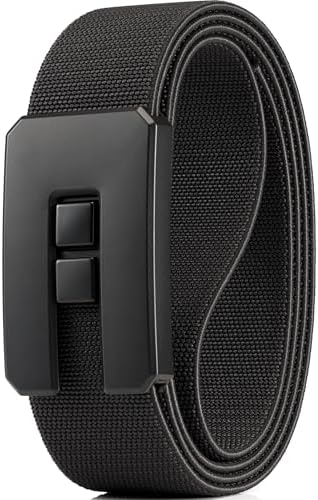
Stretch Belts
1.5" Minimalist Ratchet Belt - Black, waist 28"-34"
Ratchet belt: micro-adjustment instead of fixed holes.
waist 28"-34"
Guide · Belts
A ratchet belt arrives longer than you need. That is deliberate, and the ten minutes you spend trimming it decide how the belt sits for the next few years.
GEIT sells belts in three waist bands rather than in single inches: 28 to 34, 35 to 38 and 39 to 42. Measure over the trousers you actually wear the belt with, through the loops, not over bare skin. A tape pulled tight gives you a number an inch smaller than the one you need.
If your measurement lands on a boundary, take the larger band. A ratchet strap can be shortened at home and cannot be lengthened, so the expensive mistake only goes one way.
| Measured waist | Band to order |
|---|---|
| 28 to 33 in | 28" - 34" |
| 34 in | 28" - 34" if the trousers sit high, 35" - 38" if they sit low |
| 35 to 37 in | 35" - 38" |
| 38 in | 39" - 42" |
| 39 to 42 in | 39" - 42" |
A punched belt gives you holes an inch apart, and most waists sit somewhere between two of them. The track on a ratchet strap has teeth close enough together that you land within a quarter inch of where you wanted to be. After lunch you push it one tooth looser and nobody watching can tell.
The release is a lever under the buckle. Press it and the strap slides free in one movement, which is the part people notice first and the part that has to survive a few thousand cycles. That is why the track is metal on these models.
Cut square across with sharp scissors, or with a utility knife against a straight edge. Nylon and canvas both fray, so a clean single cut beats a sawing motion. Cut on the long side of your mark. You can always take another half inch off; you cannot glue it back on.
Some people run a lighter along a nylon cut edge for a second to seal it. Keep it quick and keep the flame off the webbing face. Canvas will not seal, so cut it clean and leave it.
Two common causes. The strap is threaded upside down, so the teeth are not meeting the pawl and the belt slips a notch under load. Or the buckle sits off centre because the tail was cut short and now pulls to one side. Rethreading fixes the first. The second is why you cut long.
For a belt you do not want to trim at all, the stretch nylon models close with a quick-release or a plain buckle and size themselves inside the band. Different job, no scissors.
Ratchet belt: micro-adjustment instead of fixed holes.
waist 28"-34"
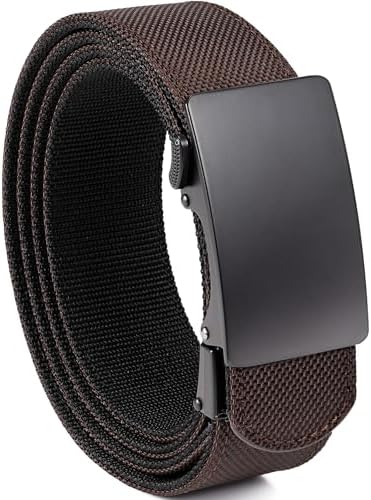
Canvas strap, 35 mm, cut to length at home.
waist 39"-42"
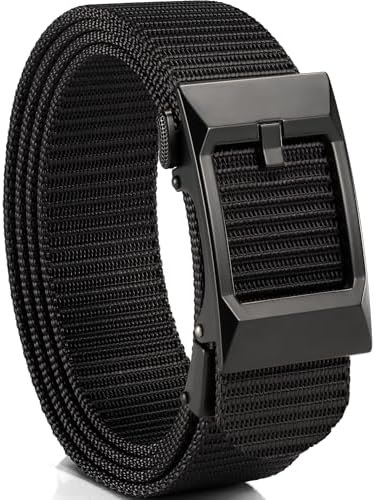
Plain nylon web ratchet belt, 35 mm, trimmable.
waist 35"-38"